Joseph Hall invented Perl Graphical Structures, which he used in Effective Perl Programming and we used in Intermediate Perl. To make the images for the first and second editions, I wrote PeGS::PDF (on Github).
I used this to create all of the PeGS structures in the book. Here are a couple of examples, which you can also find in the distribution. I can make the basic structures from Learning Perl as well as the references and structures from this book. I can't make arbitrarily deep structures because I didn't do the work to recursively place everything in non-overlapping spaces.
#!/usr/local/bin/perl

use PeGS::PDF;

my $W    = 1.50 * 72;
my $H    = 2.25 * 72;

my $pdf = PeGS::PDF->new(
	{
	file => "/Users/brian/Desktop/array.pdf",
	'x'  => $W,
	'y'  => $H,
	}
	);
die "Could not create object!" unless ref $pdf;

$pdf->make_array( '@cats', [ qw(Buster Mimi Ginger Ella) ], 10, 120 );

$pdf->close;
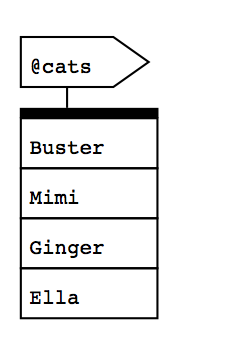
@catsI can also make a hash.
#!/usr/local/bin/perl

use PeGS::PDF;

my $W    = 2.5 * 72;
my $H    = 2.25  * 72;

my $pdf = PeGS::PDF->new(
        {
        file => "/Users/brian/Desktop/hash.pdf",
        'x'  => $W,
        'y'  => $H,
        }
        );
die "Could not create object!" unless ref $pdf;

my %microchips = qw(
        Buster  1435
        Mimi    9874
        Ella    3004
        Ginger  5207
        );

$pdf->make_hash( '%microchips', \%microchips, 10, 120 );

$pdf->close;
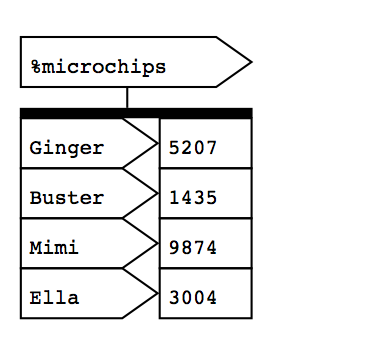
%microchips